Home > Products > SenSpot™ > Wireless Sonar
The Wireless Sonar SenSpot™ is a high-performance solution for collecting underwater data, such as depth and water temperature. This wireless sonar sensor is easy to install and scalable, featuring a high-capacity lithium-ion battery and solar panel mount, eliminating the need for battery replacement. With IP67 protection, it is completely weatherproof, making it ideal for marine applications in hard-to-access locations.
The sonar transducer uses an AIRMAR EchoRange™ 200KHz sensor, renowned for its accuracy in measuring underwater depth and temperature. Resensys proprietary wireless technology ensures efficient large-scale sensing, wireless synchronization, and ultra-energy-efficient communication in the Wireless Sonar SenSpot™.
Additionally, the Wireless Sonar SenSpot™ can function as a repeater, extending the communication range between other SenSpot™ sensors and their SeniMax™ datalogger.

without battery replacement

10 mm depth resolution

Stainless-steel mount / flange mounted (concrete)

1 km fee space

easy to reuse in other places

-40 to +65°C (-40 °F to +150°F)
• Long battery life• Lightweight• Wireless data transmission• Easy mounting (flange mount or adhesive tape)• IP67 weatherproofing• Maintenance-free operation
• Underwater navigation: Assist in safe navigation by avoiding obstacle for vessels and submersibles.• Hydrography and Bathymetry: Map underwater terrain and water depths.• Pipeline inspections: Conducts accurate inspections of underwater pipelines for integrity and safety.• Marine salvage: Assists in locating and recovering sunken objects and vessels.• Underwater target identifications: Assist in locating and identifying underwater objects for marine operations.• Search and recovery: Locates and retrieves lost objects or bodies underwater.• Ocean science, discovery, and academic research: Collect data for oceanographic and various marine studies.

A wireless sonar sensor is a device used to measure underwater distance, sediment levels, or water depth using sound waves. It transmits acoustic signals toward the surface or riverbed and calculates the distance based on the returning echo, sending the data wirelessly to a monitoring system.
Wireless sonar sensors are typically installed in rivers, reservoirs, dams, canals, and marine structural health monitoring system. They help monitor underwater conditions and provide critical data for water resource management and infrastructure protection.
Underwater monitoring helps engineers understand changes in water depth, sediment movement, and riverbed conditions. Using a wireless sonar sensor, engineers can detect changes that may affect bridges, dams, or other hydraulic structures.
Wireless sonar monitoring systems eliminate the need for extensive cabling in water environments. They allow sensors to transmit real-time underwater measurements remotely, enabling efficient monitoring across large water bodies and remote locations.
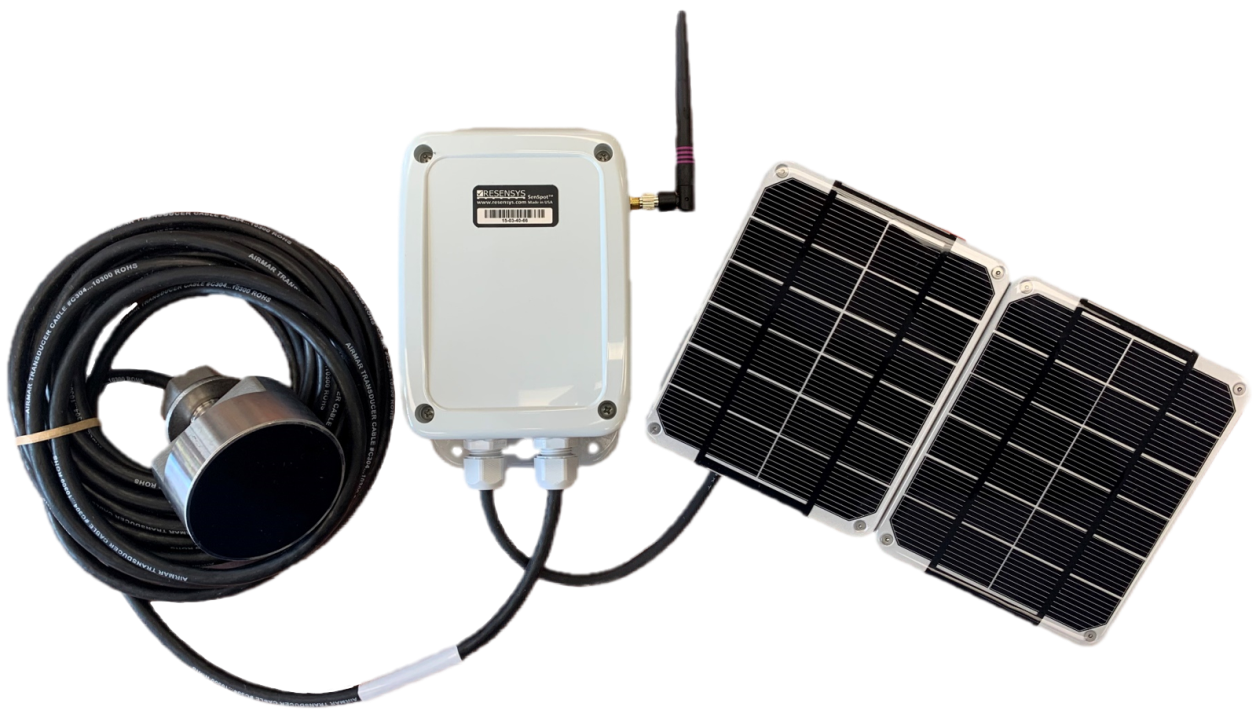
▪ Storage temperature range: -30°C to +70°C (- 40°F to +150°F)
▪ Operating temperature range: -5 to 60°C (23 to 140°F)
▪ Wireless communication range: 1.0km (0.62mi) free space
▪ Cable
o Length: 7.6m (25ft)
o Type: C304, four shielded twisted pair
o Reverse polarity protection
▪ Water Temperature
o Accuracy: ±0.05°C
o Resolution: 0.09°C
▪ Depth
o Minimum reading: 0.4 m (15”)
o Maximum reading: 200 m (656ft)
o Display resolution: 10 mm (4”)

Small wireless sensors that
make big differences
Address: 6517 Mid Cities Ave.
Beltsville MD 20705
USA
E-Mail: info@resensys.com
Phone: (301) 477 3075


